Dublin, Royal Irish Academy MS 23 A 4 (469)
Siobhán Barrett
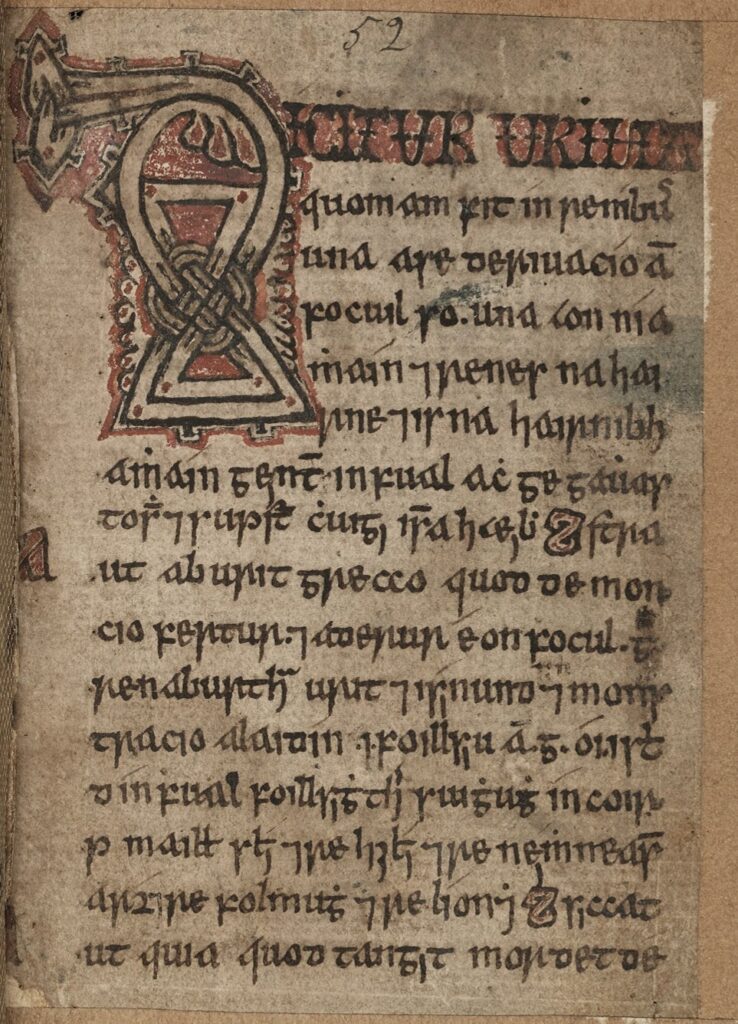
Fig. 1: Dublin, Royal Irish Academy MS 23 A 4 (469), p. 52: The opening words, Dicitur Urina, of the Carmen de Urinis by Gilles de Corbeil, who was also known as Aegidius. Image courtesy of Irish Script on Screen.
This paper manuscript of 178 pages is divided into two parts. The first part (pp. 1–139) is the earlier of the two and is signed by its scribe, Aodh Ó Cendamháin, on p. 81. As well as his signature, this page contains two greetings: Beannacht agat a Carpre o Aodh O Cendamain (‘a blessing on you Cairbre from Aodh Ó Cendamháin’) and co nderna sin maith duit a Chairbre (‘that it may do you good, Cairbre’). It is thought that these men were brothers and physicians to the O’Flahertys of Co. Mayo. They also collaborated on London, British Library MS Add. 15582, a manuscript which is dated to 1563, justifying a mid-sixteenth-century date for the first part of RIA MS 23 A 4. Most of the contents of the first part of this manuscript are texts dealing with uroscopy, including a metrical text, De urinarum judiciis, also called the Carmen de Urinis, by the French physician Gilles de Corbeil/Aegidius (ca 1140 – ca 1224). It also contains treatises on the colours of urine to aid in diagnosing disease and an Irish translation of Aegidius’s De pulsibus. Other copies of these texts are found in BL MS Add. 15582 and in two other manuscripts written by Cairbre Ó Cendamháin, Dublin, Trinity College MS 1357 and Edinburgh, University Library MS La.III.21.
According to a scribal note on p. 171, the second section of the manuscript (pp. 140–end) was written in 1656 in Co. Donegal by Baothghalach Ó Fearghusa, almost 100 years later than the first part. The Ó Fearghusa family were physicians to the O’Malleys of Co. Mayo. The physician and scribe Eoghan Ó Fearghusa was the patron of TCD MS 1357 (mentioned above), written by Cairbre Ó Cendamháin, further confirming connections between these two families of hereditary physicians from Co. Mayo. This second section contains a short tract on epilepsy and its cure and a section of a text on laxatives and purging by Iohannes de Sancto Amando, a thirteenth-century author on pharmacology who taught at the University of Paris.
At the foot of p. 79 there are two lines signed by Peadar Ó Conaill, a later hand and possibly the eighteenth-century scribe of Maynooth, University Library MS C38, which also contains tracts on epilepsy and ointments.
Further reading:
- Gentilis de Fulgineo (1529), Carmina de urinarum judiciis (Basel: Thomas Wolff)
- Ó Cuív, Brian (1976), ‘The Irish Language in the Early Modern Period’, in A New History of Ireland. Volume 3, Early Modern Ireland 1534–1691, ed. by T. W. Moody, F. X Martin, F. J Byrne (Oxford: Clarendon Press), pp. 509–45
- Ó Muraíle, Nollaig (2016), ‘The Hereditary Medical Families of Gaelic Ireland’, in Rosa Anglica: Reassessments, ed. by Liam P. Ó Murchú, Irish Texts Society Subsidiary Series 28 (London: Irish Texts Society), pp. 85–113
- Wallis, Faith (2000), ‘Inventing Diagnosis: Theophilus’ De urinis in the Classroom’, Dynamis, 20, 31–73