Dublin, Royal Irish Academy MS 23 N 17 (996)
Siobhán Barrett
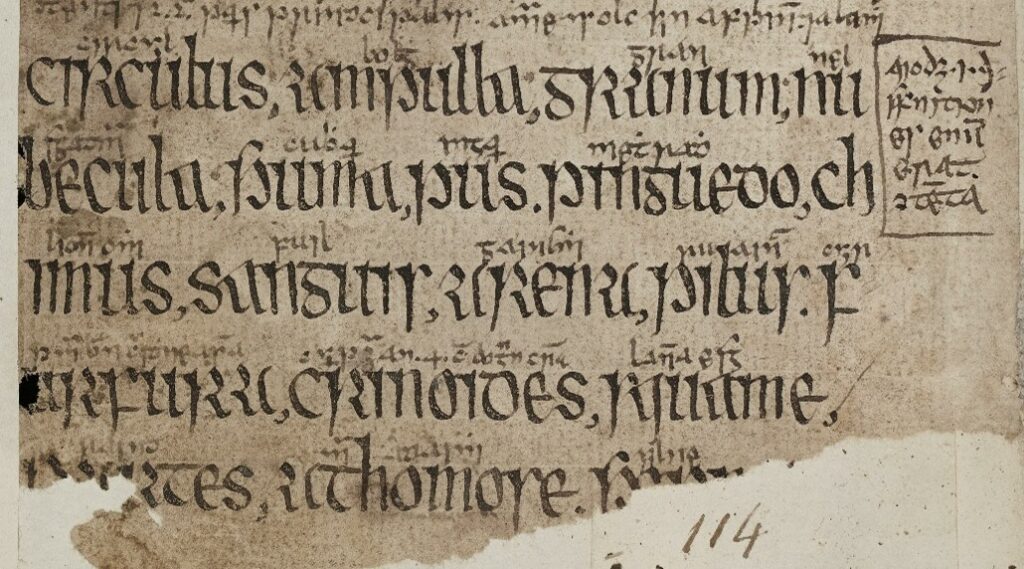
Figure 1: Dublin, Royal Irish Academy MS 23 N 17 (996), p. 114: A page from a text on uroscopy. This is a list of substances found in urine, which can aid the physician in diagnosing disease. Image courtesy of Irish Script on Screen.
This sixteenth-century composite codex contains three separate paper manuscripts written by three different scribes. The pages are small, measuring only 7 ¼ x 4 ½ inches. The first section was written in 1582 by Conchobar Óg mac Maoltuile, who is the only named scribe, at an unidentified place named ‘Caraig an Eide’. Misplaced pages from another manuscript, Dublin, RIA MS 23 I 19 (754), are bound into this one (Ní Shéaghdha 1967: 51). There is no scribal signature in the second part, but there is a note on p. 83, dated 1567, which names the place of writing as ‘Baile an Airrséraigh’, possibly ‘Archerstown’. There are at least four different townlands bearing this name, in the counties Laois, Meath, Westmeath and Tipperary. There is no scribal signature or place of writing mentioned in the third section.
The first section contains Geraldus de Solo’s commentary on the ninth book of the Liber Almansoris (‘The Book of Medicine dedicated to Manṣūr’), a systematic treatise of diseases from head to toe by Abū Bakr Muḥammad ibn Zakarīyā Rāzī (sometimes written as al-Razi, Rases or Rhazes). Geraldus de Solo’s commentary on this text served as a clinical handbook, containing quotations from many authors including Bernard of Gordon, Gilbertus Anglicus, John of Gaddedsen, Mesue and Dioscorides. Versions and excerpts of this very popular text are preserved in many Irish manuscripts.
The second section of the codex is worn and in parts illegible. Among the contents are Theophilus’s text on urine and parts of the French physician Gilles de Corbeil/Aegidius’s metrical composition Carmen de Urinis (pp. 85–125). This can be identified by the opening words of the prologue, Dicitur urina. The practice of visually examining a patient’s urine for the purpose of diagnosising disease was a standard technique used by physicians. Uroscopy texts were a core component of the curricula in the medieval European medical schools and this is reflected in their widespread presence in Irish material.
Medical definitions and aphorisms are found in the upper and lower margins, including what the cataloguer describes as ‘pious ejaculations’. The top margin of p. 79 contains an interesting healing charm to cure epilepsy by reciting the names of ‘The Three Magi’, Jasper, Melchior and Balthasar, into the ear of the person affected (see Figure 2).
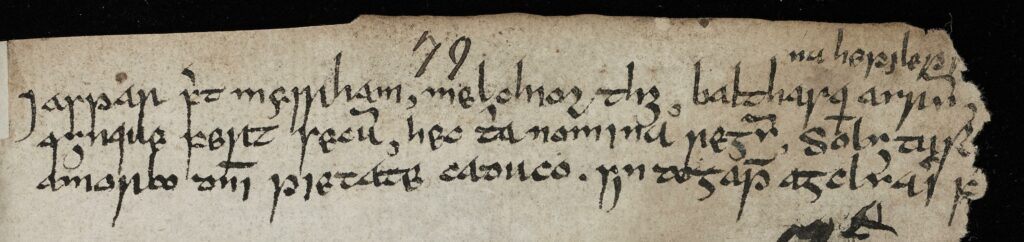
Figure 2: Dublin, Royal Irish Academy MS 23 N 17 (996), p. 79: a charm to cure epilepsy.
Further reading:
- Hayden, Deborah (forthcoming), ‘The Context and Obscure Language of Healing Charms in a Sixteenth-Century Irish Remedy Book: Four Case Studies’ in Obscuritas in Medieval Irish and Welsh Literature, ed. by Chantal Kobel (Dublin: DIAS)
- Ní Shéaghdha, Nessa (1967), Catalogue of Irish Manuscripts in the National Library of Ireland, fasc. I (Dublin: DIAS)
- O’Boyle, Cornelius (1998), The Art of Medicine. Medical Teaching at the University of Paris, 1250–1400, Education and Society in the Middle Ages and Renaissance 9 (Leiden: Brill)
- Stifter, David (2025), ‘Old Irish Healing Charms and Protective Spells’ in Medicine in the Medieval North Atlantic World: Vernacular Texts and Traditions, ed. by Deborah Hayden and Sarah Baccianti (Turnhout: Brepols)
- Thanisch, Eystein (2025), ‘Knowing through Defining: Collections of Scientific Definitions in Gaelic Medical Manuscripts’, in Medicine in the Medieval North Atlantic World: Vernacular Texts and Traditions, ed. by Deborah Hayden and Sarah Baccianti (Turnhout: Brepols), pp. 337–64
- Tuomi, Ilona, John Carey, Barbara Hillers, and Ciarán Ó Géalbháin, eds (2019), Charms, Charmers and Charming in Ireland: From the Medieval to the Modern, New Approaches to Celtic Religion and Mythology (Cardiff: University of Wales Press)
- Wallis, Faith (2000) ‘Inventing Diagnosis: Theophilus’ De urinis in the Classroom’, Dynamis 20 (2000), 31–73