Dublin, Trinity College MS H 6. 22 (1698)
Deborah Hayden
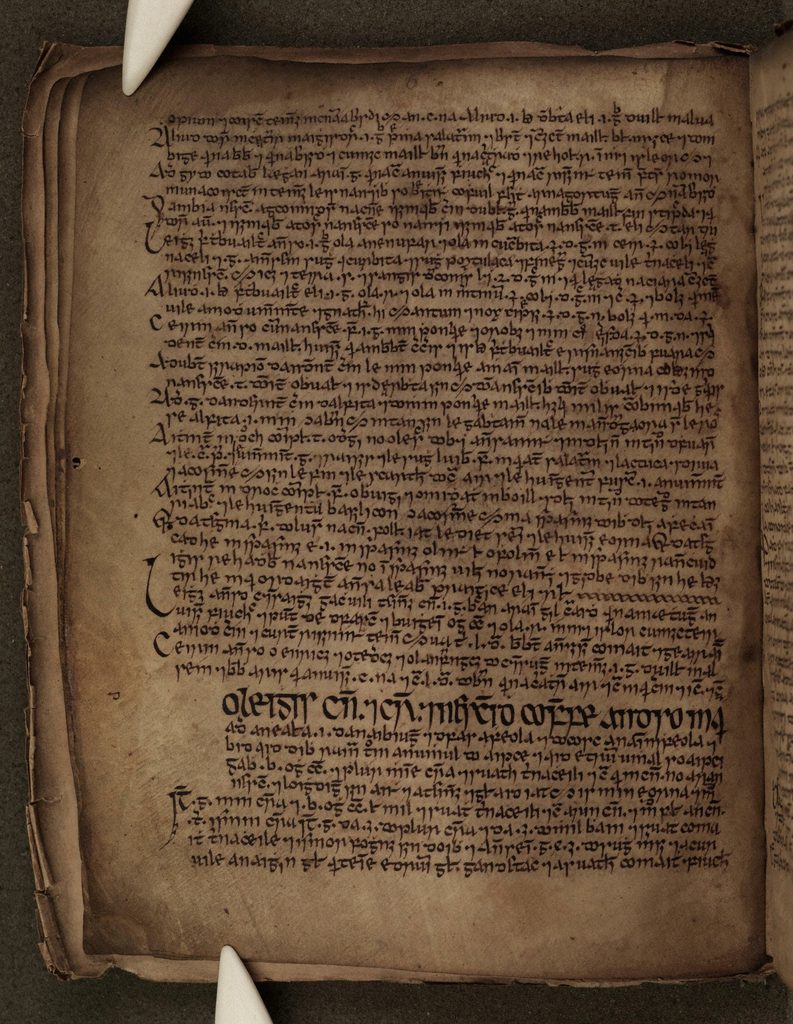
Fig. 1: Dublin, Trinity College MS H 6. 22 (1698), p. 6: the end of an Irish translation of Petrus de Argellata’s Chirurgia and the beginning of a compilatory treatise on wounds
This Irish medical manuscript comprises only sixteen pages written in single columns and contains no scribal signature. It appears to have been the work of someone with a particular interest in surgery, however, since most of its contents are concerned in one way or another with this topic. The first six pages contain excerpts from the surgical work of Petrus de Argellata, an Italian physician, surgeon and anatomist who taught and practised in Bologna during the second half of the fourteenth century; vernacular translations of his Chirurgia survive in many Irish manuscripts. Petrus de Argellata was a student of the famous Montpellier physician Guy de Chauliac, whose surgical works were also translated into Irish (Ní Ghallchobhair 2016). Some of the excerpts in this copy of Petrus’s treatise, concerning how to soothe the pain of wounds, correspond to another copy preserved in Dublin, Royal Irish Academy MS 24 P 26, written in 1469 by the Munster physician Donnchadh óg Ó hÍceadha.
The Irish translation of Petrus de Argellata’s surgical text is followed in TCD MS 1698 by a compilatory treatise, in four separate parts, on wounds and how to treat them. This includes several recipes that correspond to texts found in a short treatise on sinews that are cut or wounded by weapons in Dublin, National Library of Ireland MS G 11, p. 337. After a recipe for oxymel (a medicinal drink made of wine and honey) on p. 11 of TCD MS 1698, the manuscript concludes with a tract on diseases of the hair and head, several sections of which again correspond to texts in NLI MS G 11. Much of this compilation consists of practical remedies for ailments affecting the head, but it also includes some rudimentary anatomical theory, such as the explanation on p. 14.3 that the head is divided into four parts, each of which is dominated by a different humour. A similar statement is found in a collection of remedies for head ailments in Dublin, RIA MS 24 B 3 (p. 39z), whose early sixteenth-century scribe, the Connacht physician Connla Mac an Leagha, attributes it to the Irish god of healing, Dían Cécht; the teaching was commonplace, however, and may ultimately derive from the Viaticum of Constantine the African, who attributes it to Galen (Hayden 2019: 41–2).
Further reading:
NÍ GHALLCHOBHAIR, Eithne, ed. and trans. (2014), Anathomia Gydo (London: Irish Texts Society)