Dublin, Trinity College MS 1318 (olim H 2. 16), ‘The Yellow Book of Lecan’
Deborah Hayden
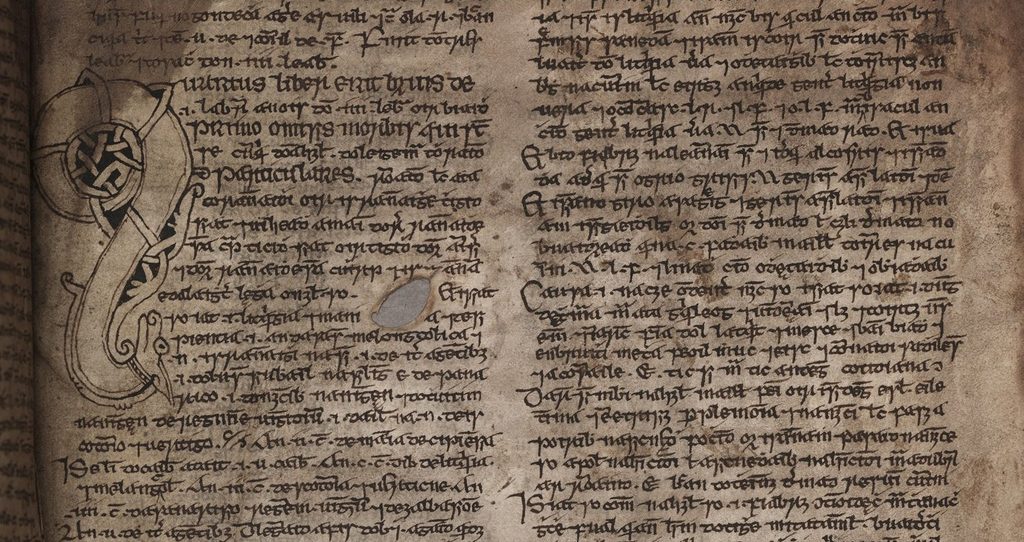
Figure 1: Dublin, Trinity College MS 1318 (‘The Yellow Book of Lecan’), cols 465-6: the beginning of a section of a medical treatise concerning diseases of the head (image courtesy of Irish Script on Screen)
Although this substantial vellum manuscript is famous for its wide variety of literary texts, including Ulster Cycle tales, saints’ lives and bardic poetry, it also includes three sections of medical writing. The manuscript known as the ‘Yellow Book of Lecan’ (a title that properly belongs only to part of the book) is a composite codex comprising numerous different fragments, including nearly 100 folios (cols 573–958) written by Gilla Ísa Mac Fir Bhisigh, poet and historian to Ó Dubhda of Tír Fhiachrach (Tireragh), Co. Sligo at the end of the fourteenth and the beginning of the fifteenth century.
The first medical fragment in this collection consists of ten folios beginning on col. 437. Its contents cover topics including wounds and ulcers, conditions affecting the nose such as nasal polyps, dental and vision problems, and concussion. The second fragment is found on cols. 477–86 and contains the end of a treatise on urine, a text on the four elements, and material concerning the generation of animals.
The third medical fragment, which comprises cols 487–99, is of some significance, since it contains the earliest dated copy of a commentary on the Hippocratic Aphorisms that had been translated into Irish in 1403 by two Munster medical scholars, Aonghus Ó Callanáin and Niocól Ó hIceadha. The copy in the Yellow Book of Lecan contains only the seventh book of this treatise, but a signature on the final page tells us that it was copied on an island in Loch Gara (referred to by the scribe as ‘Loch Tethead’), Co. Sligo in 1413 by one ‘Gilla Pádraig Albanach’, whose cognomen suggests that he may have had some association with Scotland. Gilla Pádraig further notes that the king of Connacht at that time was ‘Toirrdealbach Ruadh Ó Concubair tar éis Toirrdealbach Óig Í Concubair’, a reference to the two rival claimants to the succession of the kingship of Connacht following the death of Ruaidhrí Ó Conchobhair in 1384.
Further reading:
Cosgrove, Art (1987), ‘Ireland beyond the Pale, 1399–1460’, in A New History of Ireland, Volume II: Medieval Ireland 1169–1534, ed. by Art Cosgrove (Oxford: Oxford University Press), pp. 569–90
Ó Muraíle, Nollaig (1996), The Celebrated Antiquary: Dubhaltach Mac Fhirbhisigh (c.1600—1671) – His Life, Lineage and Learning (Maynooth: An Sagart)
Oskamp, H. P. A. (1975), ‘The Yellow Book of Lecan proper’, Ériu 26: 102–21