Dublin, National Library of Ireland MS G 12
Deborah Hayden
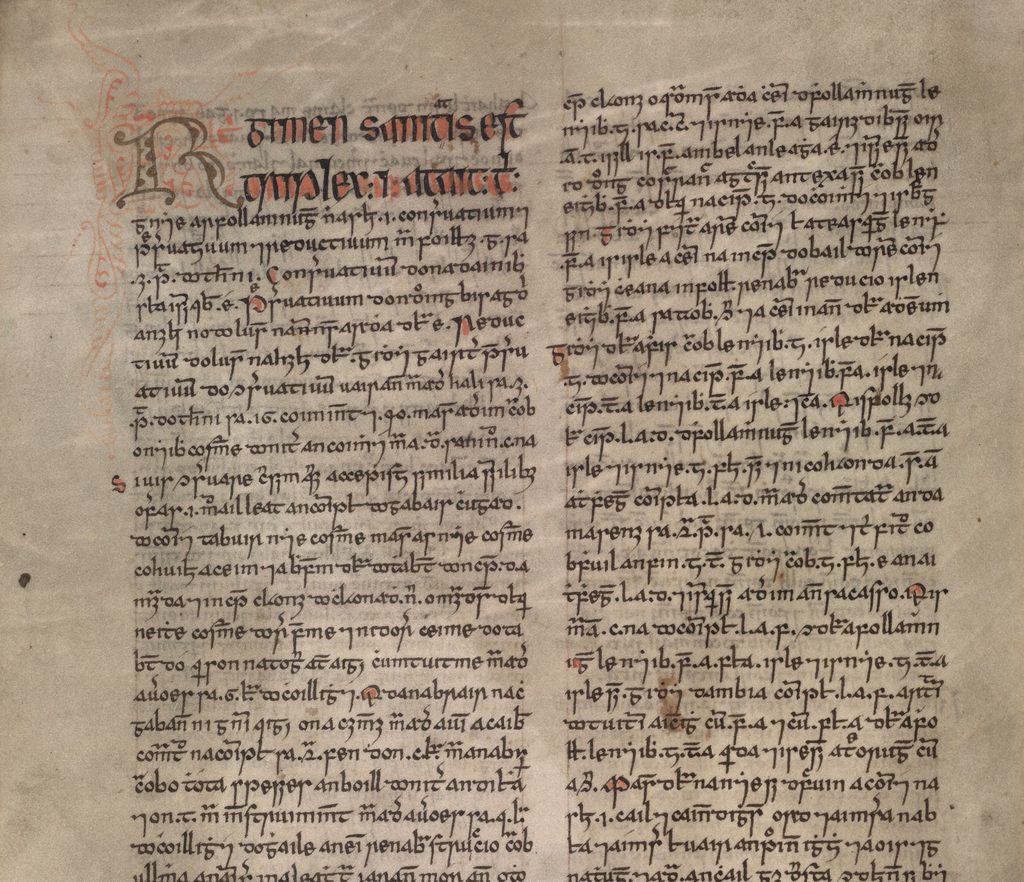
Fig. 1: Dublin, National Library of Ireland MS G 12, p. 14: the beginning of an excerpt from the Irish translation of John of Gaddesden’s Rosa Anglica attributed to Cormac Mac Duinnshléibhe (image courtesy of Irish Script on Screen)
This vellum manuscript of 86 pages was written in the early sixteenth century. The first 78 pages form the main part of the manuscript, which was copied by three scribes. The final section (pp. 79–85) consists of three fragments that did not form part of the original codex but seem to have been added at the time of binding (Ní Shéaghdha & Ó Macháin 1967–1996: I, 93–4).
Two of the scribes of the main manuscript are anonymous, but the third (who wrote pp. 25–58) is identified in a colophon on p. 30 as ‘Giolla Padraig mhac Giolla na Naomh mhic Muireadhaigh Í Chonchubhair’, who belonged to a family of scribes associated with the medical school at Aghmacart, Co. Laois. Names recorded in other medical manuscripts (including RIA MSS 3 C 19 and 23 N 17) allow us to identify Giolla Padraig as the grandfather of Donnchadh Óg Ó Conchbhair, who was head of this school from ca 1590–1610 (Ní Shéaghdha & Ó Macháin 1967–1996: I, 94).
NLI MS G 12 includes a miscellany of medical texts, including one on regimen and cures for conditions affecting different organs that are classified according to the four divisions of the body, and another containing instructions for drawing blood from the basilic vein to treat various ailments. Beginning on p. 7b, there is a compilation of cures in head-to-toe order, some of which are also found in Dublin, RIA MS 23 N 17, p. 27. An excerpt from the Rosa Anglica by the English physician John of Gaddesden, beginning on p. 14 of our manuscript (Fig. 1) is the only copy of this popular tract to attribute the Irish translation to Cormac Mac Duinnshléibhe (fl. ca 1459; see p. 22). This figure, who describes himself in London, British Library MS Arundel 333, fol. 113v25 as a basiller a fisigeacht (‘bachelor of medicine’), suggesting university training, belonged to a medical family who were hereditary physicians to the Ó Domhnaill family in Tír Chonaill (Co. Donegal). Cormac is known to have produced at least nine translations of Latin medical texts into Irish (Nic Dhonnchadha 2004).
NLI MS G 12 also includes the earliest extant copy of an Irish rendering of the Montpellier physician Bernard of Gordon’s De decem ingeniis curandorum morborum (on ten methods for curing diseases), written in 1299; the Irish translation is again attributed to Cormac mac Duinnshléibhe (p. 30). Other fragmentary copies of this text are found in Dublin, RIA MSS RIA 3 C 19 and 24 P 15, as well as Edinburgh, NLI MS 2076 (see our Manuscript of the Month entry for March 2024). A copy of the Irish translation of Lanfranc of Milan’s Chirurgia Magna begins on p. 59 of NLI MS G 12 and contains more of the text than is found in the fragment from Dublin, RIA MS 23 N 16 that was published by Winifred Wulff (1930).
There are numerous short texts and notes on various topics of a practical nature in this collection, such as preparing honey for medicinal syrups and how to make the best hot bath. That medical themes, like legal principles, could be cast into the mnemonic form of triads, tetrads and heptads so commonly attested in the medieval Celtic languages is evidenced by a list of the seven herbs that are useful for treating the eye, including bitoine ‘betony’, uiruena ‘vervain’, eufrasia ‘eyebright’, selidonia ‘celandine’, siler montana ‘laserwort’, finel ‘fennel’ and ruibh ‘rue’. (p. 37a).
Further reading:
- NIC DHONNCHADHA, Aoibheann (2004), ‘Mac Duinnshléibhe [MacDonlevy], Cormac’, Oxford Dictionary of National Biography, ed. William Whyte
- NIC DHONNCHADHA, Aoibheann (2006), ‘The Medical School of Aghmacart, Queen’s County’, Ossory, Laois & Leinster 2: 11–43
- NÍ SHÉAGHDHA, Nessa and Pádraig Ó MACHÁIN (1967–1996), Catalogue of Irish Manuscripts in the National Library of Ireland,13 fasc. (Dublin: DIAS), I, pp. 93-100
- WULFF, Winifred (1930), ‘On the Qualitees, Maners, and Kunnynge of a Surgean Etc.’ Zeitschrift Für Celtische Philologie. Zeitschrift für Celtische Philologie 18 (1): 249–86