Dublin, Trinity College MS 1323 (H. 3. 4)
Siobhán Barrett
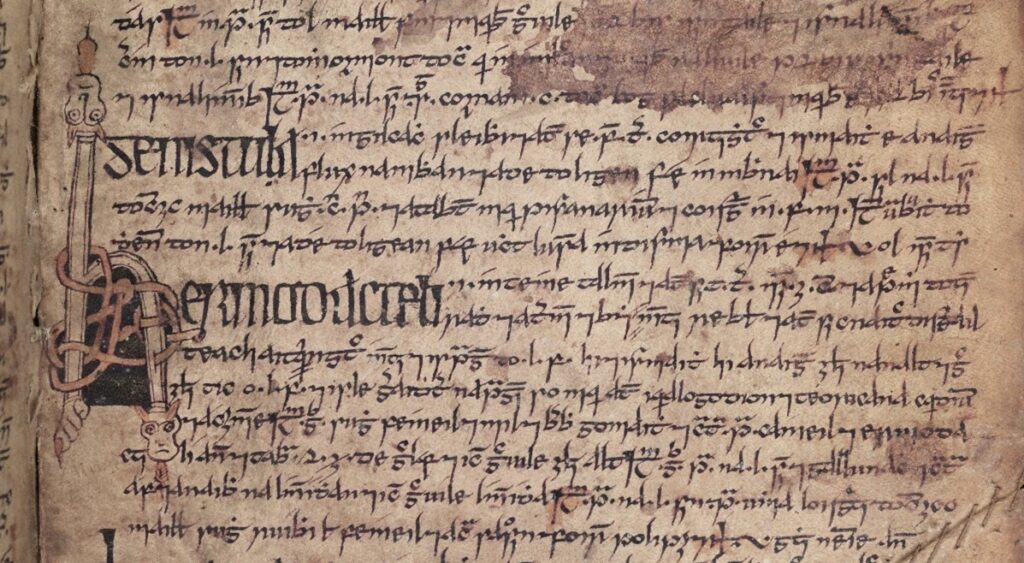
Figure 1: Dubin, Trinity College MS 1323 (H. 3. 4), p. 27: a zoomorphic initial letter ‘H’ with a claw and two fire-breathing heads (image courtesy of Irish Script on Screen)
This is a composite of two separate vellum manuscripts dating from the sixteenth century. An enclosed label states that it belonged to the O’Shiels, a medical family with connections to the north-west of Ireland.
The material in this manuscript is pharmaceutical in content, including a Materia medica, or Latin-Irish medical dictionary in which each entry begins with the Latin name of a medicinal ingredient followed by its Irish name and examples of the ailments for which its use is recommended, also in Irish. A colophon on page 63 credits Tadhg Ó Cuinn as the person who originally translated this text into Irish, with Aengus Ó Callanáin named as his amanuensis. Another copy of this text, which is found in TCD MS 1343 (see our Manuscript of the Month entry for June 2024) has been edited and translated by Mícheál Ó Conchubhair. The colophon in TCD MS 1323 also gives the name of one of the scribes, Maghnus Mac Gilla na Naem Mac an Leagha. Another note on the upper margin of p. 81 is signed by one ‘Dabiudh’, but his surname is unknown. Two other medical scribes have signed their names in ogham on the bottom margins of p. 32 and p. 33. The first of these is thought to be Máel Eachlainn Mac an Leagha, the scribe of King’s Inns MS 15 (see our Manuscript of the Month entry for October 2024) and Edinburgh, National Library of Scotland Adv. MS 72.1.4. The second one is believed to be his brother, Connla Mac an Leagha, the scribe of Dublin, Royal Irish Academy MS 24 B 3 (445) and of Dublin, Royal Irish Academy MS 23 N 29 (467).
Materia medica texts are usually ordered alphabetically, but because the pages of this manuscript have become disordered, the first item listed begins with the letter ‘C’: [C]arduus benedicte, or torcan in Irish, tentatively ‘groundsel’ in English. Items beginning with the letter ‘A’ start on p. 11. A large decorative initial letter ‘H’ on p. 27 (see Figure 1 above) is the first letter in the plant name hermodacteli [sic],or teine talman in Irish, which is recommended as an appropriate purge for diseases caused by an excess of phlegmatic humour. The toxic nature of this plant, known in English as ‘meadow saffron’, may have inspired the scribe to incorporate the dangerous-looking claw and two fire-breathing heads into this letter ‘H’.
Further reading:
- Abbott, Thomas Kingsmill, and Edward John Gwynn (1921), Catalogue of the Irish Manuscripts in the Library of Trinity College, Dublin (Dublin: Hodges, Figgis & Co), pp. 117–18 and 352
- Hayden, Deborah (2023), ‘Ogham Script in Irish Medical Tradition’, OG(H)AM Project Blog, 24 March
- Nic Dhonnchadha, Aoibheann, Catalogue of TCD MS 1323 on ISOS
- Stokes, Whitley (1888) ‘On the Materia Medica of the Mediaeval Irish’, Revue Celtique 9: 224–44
- Ó Conchubhair, Mícheál, ed. and trans. (1991), Tadhg Ó Cuinn, An Irish Materia Medica
- Walsh, Paul, ‘An Irish Medical Family – Mac an Leagha’, Catholic Bulletin 25 (1935), 646-53; repr. in Irish Men of Learning. Studies by Father Paul Walsh, ed. by Colm Ó Lochlainn (Dublin: At the Sign of the Three Candles, 1947), pp. 206–18