Dublin, National Library of Ireland MS G 453
Deborah Hayden
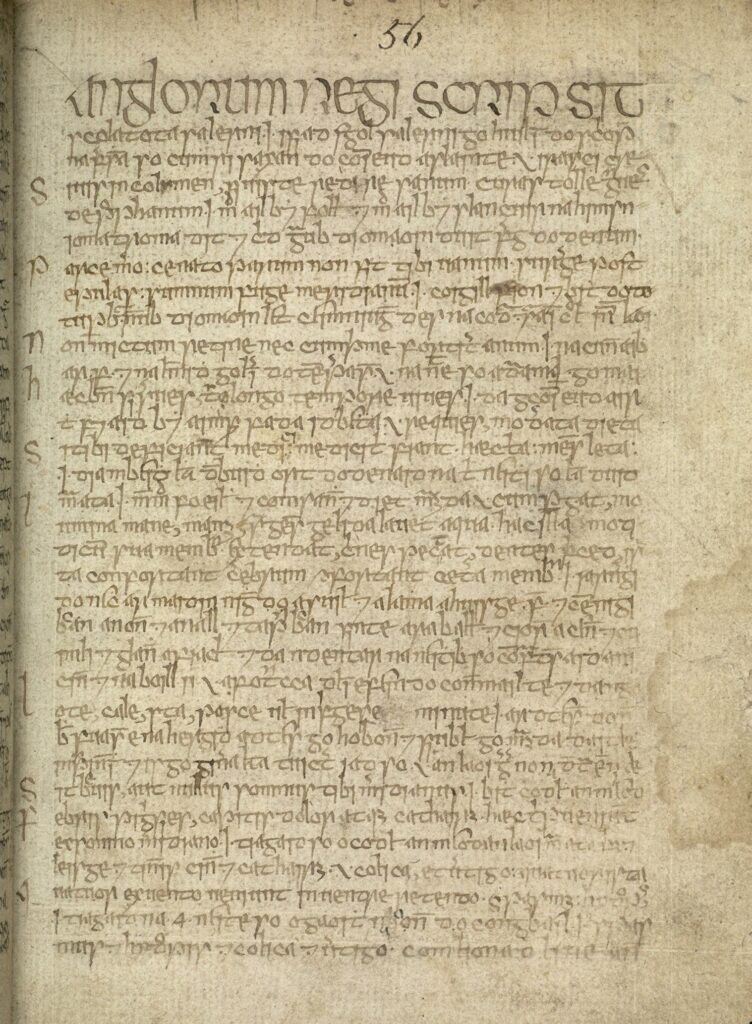
Figure 1: Dublin, National Library of Ireland MS G 453, fol. 56r: The beginning of an Irish translation of the Regimen sanitatis Salernitanum, a versified work on health regimen (image courtesy of Irish Script on Screen).
This sixteenth-century paper manuscript of 256 pages is the work of at least 25 anonymous scribes. It was written for Tadhg Mac Caisín, who added several marginal entries himself. Tadhg Mac Caisín belonged to a hereditary medical family that is known to have been practising since at least the early fifteenth century and had apparently been unsuccessful in contesting the post of official physician to the Mac Giolla Phádraig dynasty in Ossory a century later (Nic Dhonnchadha 2006: 13 and 35–6).
NLI G 453 has connections with London, British Library MS Egerton 159 (see our Manuscript of the Month entry for April 2026), another manuscript compiled for (and primarily written by) Tadhg Mac Caisín. In addition to similarities in scribal hands, fols 3–8 of Egerton 159 comprise six of the approximately nine leaves that are missing from G 453 after fol. 109v, where a copy of the Aphorismi of Johannes Damascenus (al. Mesue, d. 857) breaks off incomplete (Nic Dhonnchadha 2006: 38).
The main hand of G 453 has been identified as Cathal Ó Duinnshléibhe, who may have been a member of the kindred of this name from Ulster who served as hereditary physicians to the O’Donnells of Tír Chonaill. It is possible, therefore, that he was not a native of Ossory, but had travelled to study and work at the medical school established at Aghmacart, Co. Laois by the Ó Conchubhair medical family (Nic Dhonnchadha 2006: 39). Cathal’s hand also appears in a copy of an anonymous Irish translation of the Dispensatorium of the German physician and botanist, Valerius Cordus (1515–44) that is found in Dublin, Trinity College MS 1437 (another copy of this text occurs in Dublin, National Library of Ireland MS G 414, on which see our Manuscript of the Month entry for December 2024). Cathal was also the principal scribe of Dublin, Royal Irish Academy MS 23 N 16, a miscellany of medical texts that he wrote for his own use at various locations in Upper Ossory between 1596 and 1611 (Nic Dhonnchadha 2006: 39–40).
The contents of NLI G 453, much of which was written around 1592/3, are miscellaneous. The first several folios contain medical and metaphysical definitions and an Irish translation of Nicolaus Leonicenus’s version of the Hippocratic Aphorisms. This is followed by notes on topics such as astrology, the growth and development of the embryo and anatomy. On fol. 56r begins a copy of the popular text known as the Regimen sanitatis Salernitanum, a versified work on health regimen that circulated in several different versions; this copy of the Irish translation, which was completed by Cathal Ó Duinnshléibhe in 1592, begins with a dedication to the king of England (Wallis 2010: 487–92; see Figure 1). The manuscript also contains an Irish translation of the Hippocratic Prognostics, dated by Cathal to 11 January 1592 (fol. 85vz) and renderings of the Carmina de urinarum iudiciis and the De pulsibus of the French physician, Aegidius Corboliensis (c. 1140 – c. 1224). It ends with a copy of the Irish version of the anatomical text by the fourteenth-century French physician and surgeon, Guy de Chauliac (Ní Ghallchobhair 2016).
Further reading:
- Jacquart, Danielle and Gérard Troupeau, eds and trans. (1980), Yūḥannā ibn Māsawayh (Jean Mesue), Le livre des axioms médicaux (Aphorismi) (Geneva: Librairie Droz)
- Ní Ghallchobhair, Eithne, ed. (2014), Anathomia Gydo, Irish Texts Society 66 (London: Irish Texts Society)
- Ní Shéaghdha, Nessa (1987), Catalogue of Irish Manuscripts in the National Library of Ireland, Fasciculus X: MSS. G 434–G 500 (Dublin: DIAS), pp. 33–9
- Nic Dhonnchadha, Aoibheann (2006), ‘The Medical School of Aghmacart, Queen’s County’, Ossory, Laois & Leinster 2: 11–43
- Wallis, Faith, ed. (2010), Medieval Medicine: A Reader (Toronto: University of Toronto Press)